
A useful product specification example converts a product idea into requirements that a manufacturer can review: intended use, material direction, dimensions, construction, appearance, function, branding, packaging and acceptance criteria. The details change by category. Cutting boards prioritize food-use context and working-surface features; bamboo trays prioritize usable area, rims and handles; storage products prioritize internal fit, access and compartment layout. SHENGLIAN uses this specification-led approach to support technical feasibility review, sample development and production planning. Buyers preparing a sample brief can also consult Prototype and Sample Development for the role of samples in confirming project details.
The structures below are illustrative briefing examples, not fixed manufacturing standards, guaranteed tolerances or compliance claims. Treat each numeric field as a project-to-confirm value unless it is supported by a controlled drawing, approved sample, stated measurement method and applicable destination requirements. A technical specification can cover dimensions, quality, safety, production, packaging, marking and labelling, as summarized in technical specification requirements for dimensions, safety, packaging and labelling.
What a Product Specification Example Must Define Before Manufacturing Review
Before requesting technical review, separate the buyer’s decisions into four statuses: fixed, preferred, open and evidence required. A fixed item must be followed unless feasibility changes it. A preferred item guides development but may be adjusted. An open item needs a manufacturing decision. An evidence-required item needs a drawing, sample, test record, destination rule or other named reference before approval.
Every numeric requirement also needs a unit and measurement basis. An overall dimension describes the product’s external envelope. A critical dimension affects fit, function or appearance, such as board thickness, tray rim height or a storage compartment width. A usable dimension describes the space available to hold, carry or organize something. A reference condition records the state in which comparison is made, which can matter when material movement affects fit or dimensional review. An acceptance criterion states how the result will be judged, such as a measured feature, approved sample or defined visual condition.
| Specification field | Cutting board | Bamboo tray | Storage product |
|---|---|---|---|
| Primary use decision | Food preparation, serving or gifting | Carrying, presentation or organization | Fit, closure, organization or display |
| Critical geometry | Length, width, thickness, groove or opening | Outside size, usable area, rim and handle position | Outside size, internal size, clearance and access |
| Construction focus | Panel or multi-component build, edge and feet | Base, wall or rim, handles and joints | Lid, dividers, inserts, joints and movement |
| Evidence to request | Finish and destination food-use requirements | Fit, pack-out and any defined stability test | Object dimensions, construction sample and pack-out |
Example: Illustrative Buyer Brief Review
A private-label buyer has target uses, reference images and retail packaging goals for one cutting board, one serving tray and one lidded storage box. Critical dimensions, finish evidence, food-contact requirements and pack-out details remain incomplete. The correct decision is to create separate category-specific fields, mark unresolved items open or evidence required, and request manufacturer feasibility review before sample approval. The next submission should include marked-up references, critical dimensions, intended use, branding files, packaging inputs and required destination evidence. This is an illustrative scenario, not a SHENGLIAN project result.
The Core Specification Fields Shared by Bamboo and Wood Products
Begin with one reusable product brief, then add category-specific fields. Record the product identity, intended user, use environment, target market, quantity, destination and reference materials. State whether the route is OEM, where the buyer controls a drawing or sample; ODM, where concept development remains open; or private label, where product, branding and retail packaging are coordinated together.
Product identity, use and reference condition
Write the intended use in observable terms: food preparation, serving, countertop organization, drawer storage or display. Attach reference images, existing samples or drawings, but label what each reference means. One image may define the silhouette, another the handle position, and another only the colour direction. State which reference has priority when they conflict. If dimensional comparison, panel fit or movement matters, record the relevant moisture or reference condition instead of assuming that an unstated condition will be acceptable.
Dimensions, material and construction
List overall dimensions separately from functional and usable dimensions. Define the material or construction direction, such as solid, laminated, panel or multi-component construction, without inventing a material grade. Identify visible grain direction and the acceptable range of natural variation. Call out handles, feet, inserts, dividers, lids, hardware, joins, recesses and openings. These details guide cutting, forming, panel pressing, CNC machining, sanding and assembly review where applicable.
Appearance, branding and packaging
Replace “premium quality” with inspection points: smoothness, edge feel, finish consistency, component fit, decoration legibility and packaging condition. Specify the visible faces, colour or gloss direction, finish approach and logo location. Packaging should be divided into product presentation, retail pack, inner packing and export carton, with artwork, labels, barcodes, inserts, quantities and protection requirements identified separately. This prevents a product specification from being approved while the packaging brief remains ambiguous.
Fixed, preferred, open and evidence-required fields
A practical one-page brief can use these columns: field, buyer input, status, measurement or reference basis, manufacturer confirmation and evidence required. Keep revision control readable: each drawing, artwork file, packaging brief and physical sample may have its own identifier, revision and approval date. A release log should cross-reference the exact versions reviewed and approved together. SHENGLIAN’s specification-led process uses current project files, approved samples and relevant supplier, inspection or test information; missing values should remain open rather than being filled with generic assumptions.
Illustrative Cutting Board Specification: Food Use, Working Surface and Geometry
A cutting board specification begins with use. Confirm whether the item is intended for food preparation, serving or gifting, because that decision affects the functional features, finish discussion, evidence request and destination review. A serving-oriented board may prioritize presentation and logo placement, while a preparation-oriented board may require closer attention to the working surface, groove, edge treatment and any requested food-use documentation.
| Field | Buyer input | Manufacturer confirmation or evidence |
|---|---|---|
| Geometry | Length, width, thickness, shape and edge or corner profile | Controlled drawing, unit and measurement condition |
| Working features | Groove, opening, handle, feet or non-slip element | Feature dimensions, purpose and inspection method |
| Material and appearance | Construction, grain direction, visible faces and finish direction | Material or finish information and approved sample |
| Branding and pack | Logo face, artwork, retail presentation and packaging | Artwork version, logo zone, pack-out and destination inputs |
Separate the board’s overall footprint from feature dimensions. State whether a groove or opening is functional, decorative or driven by packaging, and explain how it should be inspected. Do not assume that a finish, material or construction is automatically suitable for food contact, dishwasher use or performance needs. The buyer should identify the destination market and requested documentation; project-specific evidence and the approved sample determine the next decision. For additional context, see the Food-Contact Testing Requirements Guide.
Illustrative Bamboo Tray Specification: Outside Size, Usable Area and Load-Related Features
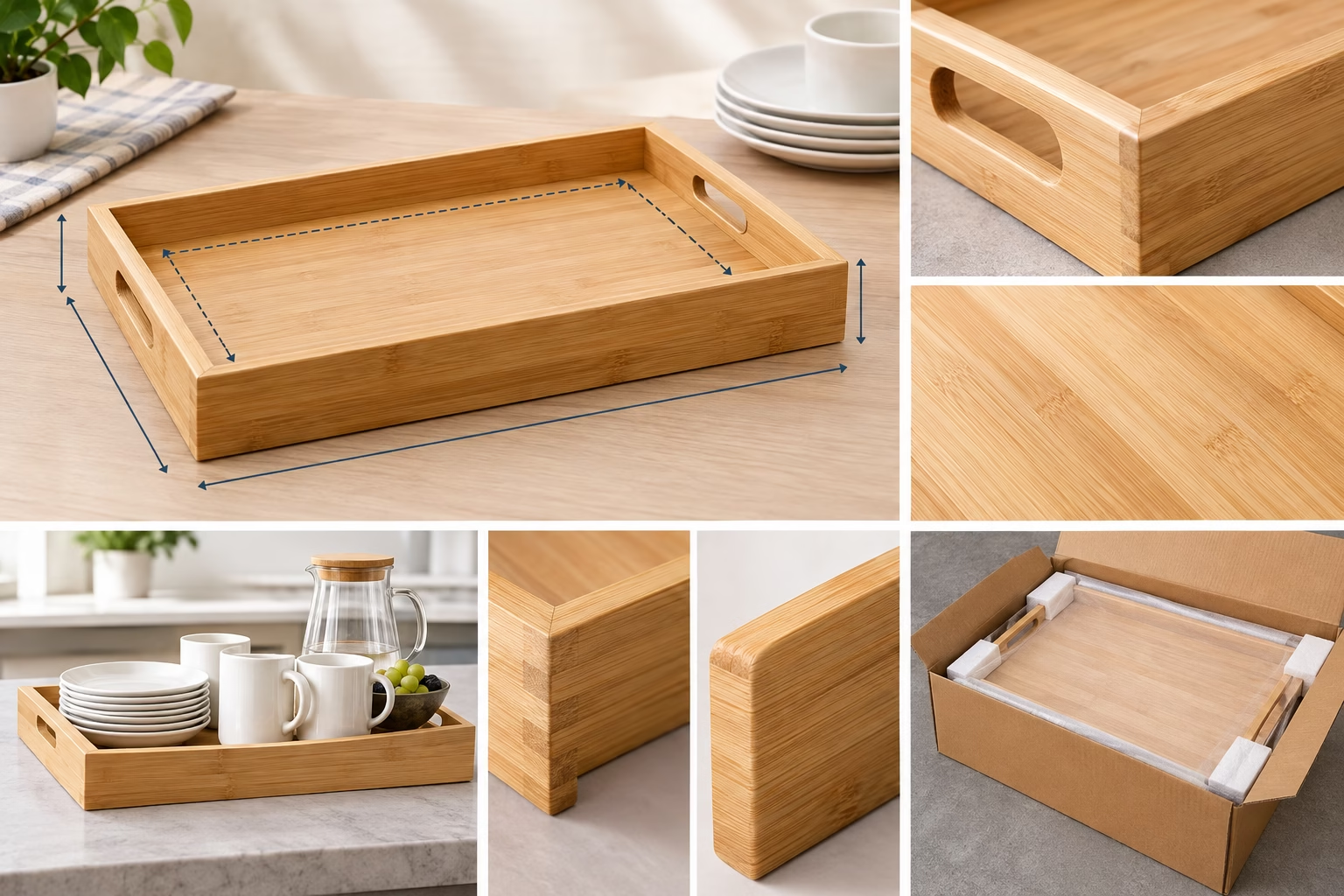
A bamboo tray specification must describe more than its overall footprint. Outside length, width and height determine whether the tray fits a shelf, carton or display location, while usable internal dimensions determine what the buyer can place inside. The rim, base, handles and joints also affect presentation and carrying use. These are separate decisions and should be recorded separately.
| Field | Buyer decision | Measurement or confirmation basis |
|---|---|---|
| Outside dimensions | Target footprint for storage, display or packaging | Dimensioned drawing with unit and measurement condition |
| Usable area | Items, gift set or tableware the tray must hold | Measured internal length, width and clearance |
| Rim and base | Raised-edge purpose, base construction and visible surfaces | Section detail, approved sample and fit inspection |
| Handles and feet | Handle type, position, access and any non-slip direction | Feature dimensions, reference image and manufacturer review |
| Branding and pack | Logo face, set configuration, retail presentation and protection | Artwork, pack-out drawing and packaging evidence |
External dimensions cannot establish capacity. A thick rim, sloped wall, recessed base or handle opening can reduce the usable area without changing the outside size. For a defined capacity, measure the usable internal geometry or compare the tray with the actual products it must contain. Do not describe a load capability unless the project has a defined test method, reference condition and result.
SHENGLIAN’s tray guidance organizes review around the three-dimensional footprint, wall or rim, base, handles, joints, intended use, branding and package. A buyer should also identify whether the tray is intended for serving, display, countertop organization or a defined gift set. That decision affects which surfaces face the customer, how clearance is judged and what pack-out evidence is needed.
Tray specification checks
- Mark outside dimensions, usable internal dimensions and rim height as separate fields.
- Show handle placement, base construction, feet, joints and edge profile on a drawing or annotated reference.
- List the products, packaging or storage location that establish the required fit.
- Define inspection points for handle position, joint fit, surface condition, branding and packaging damage.
- Keep any load or stability statement open until the method and result are agreed.
Illustrative Storage Product Specification: Fit, Access and Construction
A storage box specification or drawer organizer specification starts with the objects being stored, not only the exterior appearance. Record the stored-object dimensions, outside size, usable internal size, wall thickness and access direction. A box may need a lid, while an organizer may need open access, dividers or a controlled fit inside a drawer. Each function creates different review points.
SHENGLIAN storage guidance identifies stored objects, outside and usable size, lids, inserts, handles, stacking or nesting and joints as important brief fields. For a private-label product, connect these decisions to the retail presentation and pack-out: component count, labels, inserts, protection and carton fit should be described alongside the product itself.
Storage-product fit checklist
- Stored object: identify the item types, reference dimensions and required clearance.
- Access: state whether the product is open, lidded, drawer-based or handled, and describe lid or drawer travel.
- Organization: choose fixed compartments, removable dividers, inserts or an open interior.
- Construction: define panels or multi-component parts, joins, visible grain direction and surfaces that require review.
- Placement: provide the drawer, shelf, cabinet or display dimensions when the product must fit a specific location.
- Packaging: show component count, labels, inserts, protective materials and carton arrangement.
Usable internal dimensions should be measured inside the finished construction, not inferred by subtracting a generic wall thickness from the outside size. Clearance, lid closure and drawer travel may need confirmation with an approved sample, particularly where natural movement or multi-component construction could affect fit. Do not infer storage capacity, stacking performance or load suitability without measured geometry or agreed testing.
From Specification to Sample Approval, Quality Control and Packaging Release
A specification becomes useful when the buyer and manufacturer can inspect the same product against the same reference. Before sample approval, identify the controlling drawing or specification, the approved material or finish direction, the branding artwork, the packaging brief and the physical sample. Each file and sample may have its own identifier, revision and approval date; a plain-language release log should cross-reference the exact versions approved together.
Sample-to-production release checklist
- Product definition: compare dimensions, construction, visible surfaces, function and components with the controlling drawing.
- Appearance: inspect sanding, finish direction, natural variation, edge feel and decoration against the approved reference.
- Function: check fit, closure, handle position, usable area, divider layout or other named features using the stated method.
- Packaging: verify product presentation, retail pack, inner packing and export carton separately, including labels and inserts.
- Deviations: record each difference, decision and approval instead of silently treating the sample as the new requirement.
- Production inspection: define the inspection reference, sampling approach, measurement method and acceptance criteria before production.
Sample approval is a release input, not a replacement for production inspection. Staged checks can cover material or construction, machining and joinery, sanding and finish, branding, assembly and pack-out. Keep product net weight separate from package or gross weight. Where movement or mass matters, state the reference condition and verify the result with a conditioned approved sample rather than relying on an assumed value.
When the brief, drawing, sample and packaging direction are ready, upload the product specifications to SHENGLIAN for technical review. Include the intended use, marked-up references, critical dimensions, branding files, packaging inputs and any destination-specific evidence request. The review can then identify open feasibility questions before a sample or quotation decision.
For relevant company and manufacturing context, see Global Export and Supply Support.
Frequently Asked Questions
What information belongs in a custom bamboo or wood product specification?
Include intended use, material direction, dimensions, construction, appearance, function, branding, quantity, packaging, destination and evidence needs. Mark each field fixed, preferred, open or evidence required.
How should a cutting board specification differ from a tray specification?
A cutting board prioritizes food-use context, working-surface features and geometry such as grooves, openings or edge treatment. A tray prioritizes usable area, rim, base, handles, fit and presentation.
What is the difference between outside dimensions and usable dimensions?
Outside dimensions describe the product’s external envelope. Usable dimensions describe the internal or functional space available after accounting for rims, walls, dividers, handles, recesses or other construction features.
Should a product specification include tolerances and moisture condition?
Include them when dimensional fit, movement or inspection depends on them, but treat the values and reference condition as project decisions. The measurement method and approval source should be stated.
What evidence is needed before approving a food-use cutting board finish?
Identify the destination market, intended use, finish information and any requested food-contact documentation. Suitability should be established from project-specific evidence and review, not assumed from a product category or finish description.
How should packaging and branding requirements appear in the same product brief?
Keep product artwork, logo placement, labels, retail presentation, inner packing and export-carton requirements as linked but distinct fields. Record the approved versions together in the release log.