For custom bamboo bathroom accessories wholesale decisions, start with product fit, not the sourcing label. Wholesale may suit your brand when an existing design meets the intended use, appearance, branding and packaging needs. Custom OEM, ODM or private-label development may be a better fit when essential dimensions, layout, product details or coordinated retail presentation need more control. The right choice depends on the specific item and project, not a universal promise about price, minimum order quantity or lead time.
Begin by comparing an existing product with your requirements for countertop use, usable dimensions, finish, logo treatment and retail pack. SHENGLIAN’s Bamboo and Wooden Bathroom and Spa Products page provides product context; options for a particular accessory still need project-specific review. More control generally brings more buyer decisions, including a clearer brief and sample approvals.
Custom or Wholesale Bamboo Bathroom Accessories: Which Route Fits Your Brand?
Wholesale starts with a supplier’s existing product and the options available for that item. Custom development starts with buyer-defined requirements or a concept that needs development. Use wholesale when the product already fits the collection and channel; explore custom work when a requirement that matters to the brand cannot be met by the existing design or confirmed options.
| Decision point | Wholesale route | Custom development route | What to establish |
|---|---|---|---|
| Starting point | Existing product for evaluation | Buyer specification, reference sample or developing concept | Product information, drawing or reference images |
| Product control | Assess the available design and options | Define required changes and approve the resulting specification | Use, overall and usable dimensions, layout and function |
| Branding and packaging | Check options offered for the selected product | Specify the desired branded presentation and pack hierarchy | Artwork, labels, inserts, retail pack and destination needs |
| Sampling and buyer effort | Evaluate product and pack fit using available information and a sample where available | Provide a brief and review development samples against agreed criteria | Sample condition, acceptance points and approval responsibility |
| Commercial terms | Confirm for the selected item and order plan | Confirm for the defined development and order scope | Project-specific price, quantity and timing |
SHENGLIAN distinguishes OEM, ODM and private-label work by the buyer’s starting point and desired control. Those labels do not guarantee feasibility or establish ownership rights. Options, commercial terms and approval steps need to be agreed for the particular product and brief.
Example: A Vanity Organizer Route Decision
A US brand wants countertop storage for personal-care items and needs to assess compartment layout, finish, logo treatment and retail packaging. It has not yet compared usable dimensions, branding files or pack-out needs against an existing item, and no acceptance criteria or approved sample are available. The practical first step is an existing-product review. If critical layout, branding or packaging needs cannot be met, the buyer can move to a custom or private-label brief. Mark requirements fixed, preferred or open, then request product-specific feasibility feedback and a sample review.
What Wholesale, OEM, ODM and Private Label Actually Control
These terms describe different parts of a sourcing decision. Wholesale identifies the product starting point; OEM and ODM describe development or manufacturing approaches; private label describes how the product is presented to the market under the buyer’s brand. A project may combine private-label branding with OEM or ODM work.
- Wholesale: Select an existing product, then assess the options confirmed for it.
- OEM: Bring buyer-controlled drawings, specifications or an approved sample as the basis for development or production, where feasible.
- ODM: Bring a concept or direction while leaving more of the development work open for manufacturer input.
- Private label: Define the branded presentation, which may include agreed logo treatment, labels, inserts or retail packaging.
Using a service label does not settle intellectual-property ownership, permitted use or product feasibility. Put those matters in the project agreement where relevant, and identify which product, artwork and packaging elements each party is responsible for approving.
Terminology Checklist
- Starting point: Are you selecting an existing item, supplying controlled product files, or sharing a concept that still needs development?
- Product control: Which dimensions, construction details, layout, appearance and functions are essential?
- Branding: Which brand elements must appear on the product or its presentation?
- Approval: Who supplies the reference files, evaluates the sample and authorizes the final versions?
Confirm customization item by item rather than assuming that a route name includes a particular logo method, finish, package format or product change.
Compare the Routes by Product, Material, Branding and Packaging Control
A useful comparison separates what the buyer needs from what is already documented and what still needs confirmation. For a vanity organizer, assess the items it must hold, access to each compartment, placement on a counter or in a drawer, and whether the intended setting is wet or dry. Compare both outside dimensions and usable compartment dimensions against the actual space and objects; outside measurements alone do not establish fit.
| Requirement | Buyer input | Evidence to assess | Route implication | Confirmation owner |
|---|---|---|---|---|
| Use and layout | Items to store, location, access and essential compartment arrangement | Existing product details or a controlled sketch/specification | Wholesale if the arrangement fits; custom review if an essential layout change is needed | Buyer defines use; supplier assesses the proposed scope |
| Dimensions and construction | Space available, critical outside and usable dimensions, preferred material and construction | Measured product or sample; drawing and material/finish information | Wholesale if dimensions and construction suit; custom review if requirements differ | Buyer sets fit criteria; supplier confirms what can be assessed |
| Appearance and branding | Finish expectations, artwork and desired placement | Product sample, artwork and confirmed item-specific options | Either route may work if the required presentation is confirmed | Buyer supplies brand files; both parties agree the reference for approval |
| Packaging | Retail, inner-pack and export-carton needs; quantities, labels and inserts | Artwork and pack-out evidence showing fit, orientation and contents | Wholesale if available options fit; custom review if the pack needs development | Buyer defines market and presentation; supplier confirms project scope |
In the brief, mark each requirement fixed, preferred or open. Keep product presentation, retail packaging, inner packing and export cartons distinct: each has different dimensions, artwork, quantity and evidence needs. SHENGLIAN’s custom product RFQ guide offers a structure for communicating use, dimensions, construction, branding, quantity, packaging, destination and evidence needs. Where a requirement is not yet known, record it as open rather than filling the gap with an assumed specification.
When Wholesale Bamboo Bathroom Accessories Are the Better Fit
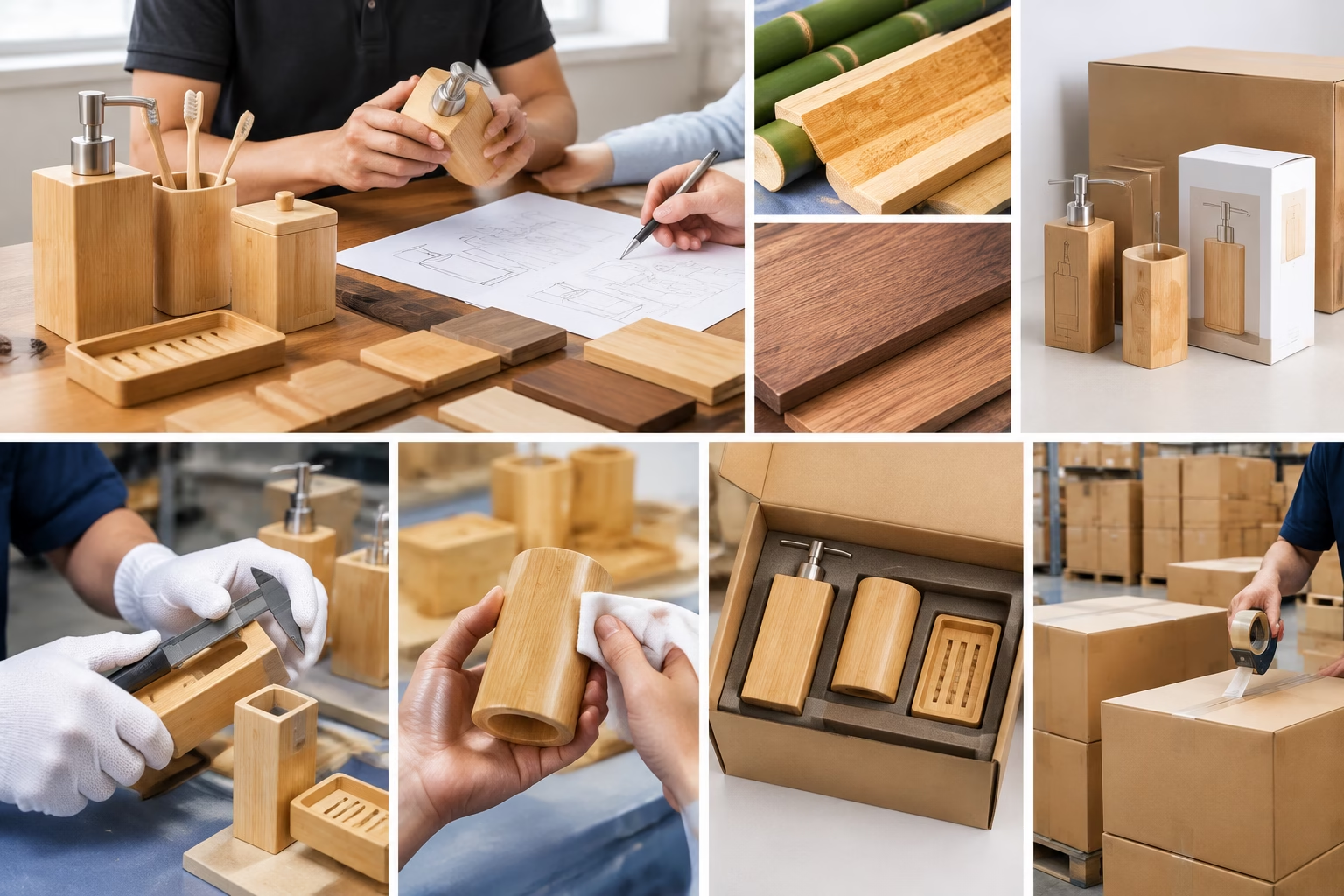
Wholesale may suit your plan when an existing accessory meets its intended use, fits your collection and can be presented with the branding and packaging options confirmed for that item. It starts with evaluating a current product—not assuming that every design is available or that customization is included.
Assess fit against the objects the product will hold and the space where it will be used. For an organizer, compare outside dimensions with usable compartment dimensions, access and item placement. Consider whether its construction and surface suit the intended setting, including any wet or dry exposure relevant to use.
Wholesale Product and Packaging Evaluation Checklist
- Product fit: Request current product information and a representative sample. Measure critical outside and usable dimensions using an agreed method, and test fit with the intended objects and available space.
- Construction and appearance: Compare the sample’s construction, joints, surface and function with your expectations. Note natural variation and any visible defects that matter to the product’s presentation or use.
- Collection fit: Check that the item’s appearance and function suit the rest of the range and the customer use case.
- Branding: Ask which branding options are confirmed for the selected item. Supply artwork or placement guidance if relevant, and agree what will be assessed against the sample.
- Packaging: Separate product presentation, retail packaging, inner packing and export cartons. Share artwork and labeling needs, and request pack-out evidence showing fit, orientation and contents.
- Approval record: Record the product, sample reviewed, measured dimensions, open questions and decisions before proceeding.
If the existing product and its confirmed options meet the essential brief, wholesale can avoid unnecessary development decisions. If an essential dimension, layout, finish or presentation need remains unmet, use that gap to assess whether a custom brief is justified.
When Custom OEM, ODM or Private Label Development Is Worth the Extra Control
Custom development may be appropriate when a product must meet defined requirements that an existing item cannot satisfy, or when coordinated branding and retail packaging are central to the range. More control also brings more buyer decisions: the brief, sample, acceptance criteria and packaging need to align before production.
OEM is a starting point when you have controlled drawings, specifications or a reference sample. ODM may fit when the concept or development direction still needs work with the manufacturer. Private label concerns the branded market presentation and can be combined with OEM or ODM. None of these labels alone establishes feasibility or intellectual-property ownership; agree project scope and permitted use in writing.
Custom Product Brief: Mark Each Field Fixed, Preferred or Open
Use this template to distinguish non-negotiable needs from preferences and unresolved questions. Attach the controlling drawing, reference images or sample where available; do not fill gaps with assumed specifications.
- Use and setting: Accessory type, intended contents, location and relevant wet or dry exposure.
- Dimensions and layout: Target outside dimensions, critical dimensions, usable compartments, access and the measurement method or reference condition for assessment.
- Material and construction: Bamboo or wood preference, construction direction, components and any defined assembly details.
- Appearance and function: Finish expectations, visual references and functions the sample must demonstrate.
- Branding: Artwork, placement preference, brand guidelines and any labels or inserts; mark undecided methods as open.
- Packaging: Retail, inner and export-carton needs, including sales unit, artwork, labels, barcodes, inserts and destination.
- Commercial and evidence inputs: Anticipated order plan, destination market, required documentation or testing, and buyer quality criteria.
- Approvals: Identify who will assess the sample, what characteristics matter, how they will be checked and what constitutes acceptance.
Ask SHENGLIAN Bamboo Wood Factory to identify assumptions, deviations and product-specific feasibility questions in its response. The Prototype and Sample Development process can support evaluation before production decisions. A broader development scope is not automatically a commercial advantage; its value depends on whether the extra control addresses a real buyer requirement.
How to Approve Samples, Control Quality and Release the Packaging
Before production, compare the sample with the buyer’s controlling product files and the physical reference sample. Assess the dimensions, construction, appearance, function and branding that matter to the brief. Record deviations and decide whether they are accepted, corrected or still open. For critical dimensions, agree the reference condition and measurement method rather than relying on an informal visual comparison.
Keep identifiers for each drawing, specification, artwork file and physical sample distinct. A release log should cross-reference the exact versions reviewed and approved together; they do not all need to share one revision code or date. SHENGLIAN’s quality-control approach should be discussed for the characteristics, inspection methods, samples, acceptance criteria and records agreed for the specific project. Sample approval does not replace production inspection.
Pre-Production Release Checklist
- Approved product sample and documented disposition of deviations.
- Current controlling drawing or specification, with dimensions and assessment methods clear where needed.
- Separate identifiers and approval dates for product files, branding artwork, packaging files and physical samples.
- Release log linking the precise approved versions together.
- Inspection plan stating each characteristic, method, sample, acceptance decision, record and disposition.
- Packaging artwork and pack-out evidence checked against the intended sales unit, contents, orientation and destination needs.
Once the route is clear, send SHENGLIAN Bamboo Wood Factory a brief marking requirements fixed, preferred or open, together with relevant reference files and packaging needs. Ask for a project-specific feasibility review and clarification of the sample, inspection and release points before making commercial assumptions.
For related quality-control and evidence context, see Food-Contact Testing Requirements Guide.
Frequently Asked Questions
Is wholesale the same as private-label bamboo bathroom accessories?
No. Wholesale starts from an existing product and its confirmed options. Private label means the product is presented under the buyer’s brand; it may be combined with wholesale, OEM or ODM depending on the project scope.
What is the difference between OEM and ODM for bamboo bathroom products?
OEM starts from buyer-controlled drawings, specifications or a reference sample where feasible. ODM involves manufacturer support while the concept or development direction remains open. Confirm the scope for the specific item.
Can a wholesale bathroom accessory receive custom branding or packaging?
Possibly, but options depend on the selected product and project. Ask the supplier to confirm available branding and packaging choices for that item before relying on them.
What should a custom bamboo bathroom accessory brief include?
Describe intended use, dimensions, layout, material and construction preferences, appearance, function, branding, packaging, destination and evidence needs. Mark each field fixed, preferred or open.
How should a buyer approve a bamboo bathroom accessory sample?
Compare it with the controlling files and physical reference sample. Assess agreed dimensions, construction, appearance, function, branding and pack fit; record deviations and the approval decision.
Does sample approval replace production quality inspection?
No. Sample approval establishes the reference for the agreed product; production inspection checks the agreed characteristics during production using the project’s documented methods and criteria.