
For importing bamboo products into the US, the key question is not simply whether the item is bamboo or wood. Before production and booking are finalized, confirm the finished product, intended use, material breakdown, origin, shipment configuration and likely classification inputs. SHENGLIAN Bamboo Wood Factory can organize these product, packaging, destination and evidence inputs through its Packaging, Warehousing and Export Preparation planning.
The importer of record remains responsible for the import entry, while the customs broker supports entry preparation and classification discussions. The supplier must provide accurate product and shipment information, and the buyer must verify current US requirements for the specific category and route. Customs entry, product compliance, food-contact review and wood-packaging review are related decisions, but they are not interchangeable. This is a procurement planning guide, not legal, customs or tariff-classification advice.
What US Buyers Must Confirm Before Bamboo or Wood Products Ship
Start with a one-page readiness gate before releasing production. The file should identify what is already confirmed, what is pending broker review and what still requires supplier evidence. A bamboo desktop organizer, a laminated serving board and a wooden storage box may share a natural material, yet their construction, intended use, components and regulatory questions can differ.
| Review area | Buyer or supplier action | Status and next action |
|---|---|---|
| Finished goods | Confirm use, construction, dimensions, components, finish and approved sample. | Confirmed, pending evidence or revise product brief. |
| Import responsibility | Name the importer of record, customs broker, supplier and freight forwarder roles. | Assign owner and obtain broker instructions. |
| Category review | Separate customs classification, food-contact, labeling and other product questions. | Identify the responsible authority or specialist. |
| Shipment configuration | Record sales unit, inner pack, export carton and any pallet, crate or dunnage. | Match the final pack-out before booking. |
Also confirm the Incoterm version, named place, duty responsibility, document ownership, booking role and cargo-readiness responsibility. Incoterms clarify commercial responsibilities; they do not prove product compliance or determine the correct tariff classification. For current route and category questions, the buyer or broker should consult International Trade Administration guidance on import regulations and relevant US authorities before shipment.
Build a Broker-Ready Product and Material Profile
A broker cannot assess a product accurately from a broad description such as “bamboo goods.” Prepare a controlled product brief containing the product name, intended use, outside dimensions, usable or internal dimensions where relevant, construction, components, finish, assembly method and country of origin. State whether the item is solid, laminated, panel-based or multi-component. Include known species or material information only when it is supported by supplier records.
For custom bamboo and wood products, the profile should connect the physical item to the evidence supporting it. Keep the approved drawing or specification, bill of materials, finish information, product photographs and sample observations together. SHENGLIAN specification briefs can distinguish fixed, preferred and open fields, so a missing value is visible rather than silently replaced with a generic assumption.
| Product attribute | Question to answer | Evidence or confirmation | Open broker question |
|---|---|---|---|
| Intended use | Is it for food presentation, storage, office use, display or gifting? | Buyer-approved use statement and artwork. | Does the use create a category-specific review? |
| Construction | Is it solid, laminated, panel-based or assembled from several materials? | Drawing, bill of materials and sample photographs. | Which construction details affect classification? |
| Dimensions | Which outside and usable dimensions are critical? | Controlled specification and measured sample. | Which dimensions should appear in shipment records? |
| Finish and components | Are coatings, adhesives, hardware, silicone or inserts present? | Supplier-supported material and finish declaration. | Is additional destination evidence needed? |
Record grain direction, natural variation, moisture reference condition and critical tolerances only when they are specified or measured. A conditioned approved sample is more useful than an estimated value when checking fit, movement, dimensions or mass. Sample approval can cover dimensions, construction, appearance, function, branding and packaging, but it does not replace production inspection.
Applied Example: Resolving an Incomplete Pre-Shipment File
A US buyer is preparing a private-label bamboo desktop organizer with bamboo components, metal hardware and retail packaging. The buyer has an approved sample and artwork, but no finalized material declaration. Export cartons are planned, and wood pallets may be used. The shipment is not yet import-ready because classification, packaging material status, country-of-origin wording and destination-specific obligations remain open.
The next action is to send the broker a controlled product brief, photographs, material breakdown, packaging hierarchy, origin information and proposed commercial-document fields. This separates known product facts from decisions requiring broker or agency review; it does not present a hypothetical scenario as SHENGLIAN performance evidence.
Assemble Commercial, Origin and Shipment Documents That Agree
Common shipment records may include a commercial invoice, packing list, bill of lading or air waybill, purchase-order reference and a product specification or material declaration when requested. The exact package depends on the shipment and responsible parties. The importer of record and customs broker should confirm filing responsibilities before cargo is released.
Cross-check the seller, buyer, product description, quantity, value, currency, country of origin, package count, net weight, gross weight and shipment references across the documents. Use a specific description, such as “bamboo desktop organizer” or “wooden serving tray,” only after broker review. “Bamboo goods” may be too vague for a useful classification discussion.
| Document | Purpose | Fields to cross-check | Discrepancy action |
|---|---|---|---|
| Commercial invoice | Describe the sale and declared value. | Parties, description, quantity, value, currency and origin. | Hold release until buyer and broker agree the correction. |
| Packing list | Describe the physical pack-out. | Cartons, contents, dimensions, net and gross weights. | Reconcile against measured final packing data. |
| Transport document | Identify the shipment and cargo movement. | Parties, package count, weight and shipment references. | Ask the forwarder to correct inconsistent data. |
| Product declaration | Provide material and intended-use facts when requested. | Components, finish, origin and supporting evidence. | Obtain supplier-supported information before submission. |
Keep net product mass separate from package or gross mass. Where mass matters for planning, use measured component data and a conditioned sample rather than inferring weight from the outside envelope. SHENGLIAN can prepare product and pack-out information for export coordination, while the buyer, broker, carrier and forwarder should confirm their respective responsibilities and the final document set.
Review Materials, Finishes, Intended Use and Product Claims
A material declaration is a factual record of what the finished product contains. It may identify bamboo, wood, metal hardware, silicone feet, coatings, adhesives, textile components or paper inserts. It should also describe the finish and intended use where these details affect the buyer’s compliance review. A declaration is not, by itself, proof that a product is accepted for a particular market or application.
This distinction matters when importing bamboo products into the US for kitchenware, tableware or food-presentation use. Customs documentation, a material declaration, a product test report and food-contact evidence answer different questions. The buyer should identify the intended use in the product brief and request current guidance for the specific product, finish and destination. The Food-Contact Testing Requirements Guide provides useful context, but project-specific acceptance still requires confirmation from the buyer’s advisor or relevant authority.
Material and Claims Review Checklist
| Item | Record | Owner or evidence | Status |
|---|---|---|---|
| Construction | Solid, laminated, panel or multi-component construction | Supplier specification and approved sample | Confirmed / pending |
| Components | Principal and secondary materials, hardware and inserts | Supplier-supported declaration | Confirmed / evidence required |
| Finish | Surface treatment and appearance requirement | Finish specification and sample observation | Confirmed / pending |
| Intended use | Kitchen, tableware, storage, office, bathroom or gift use | Buyer product brief | Buyer approval |
| Claims | Food-contact, natural-material or other marketing language | Buyer compliance owner and applicable guidance | Broker or agency review |
SHENGLIAN can organize material, finish, construction, branding and packaging inputs against controlled files. Quality checks may cover the material, surface, function and appearance, but the buyer remains responsible for ensuring that claims and destination-market obligations are appropriately reviewed.
Check Wood Packaging, Carton Configuration and Shipment Readiness
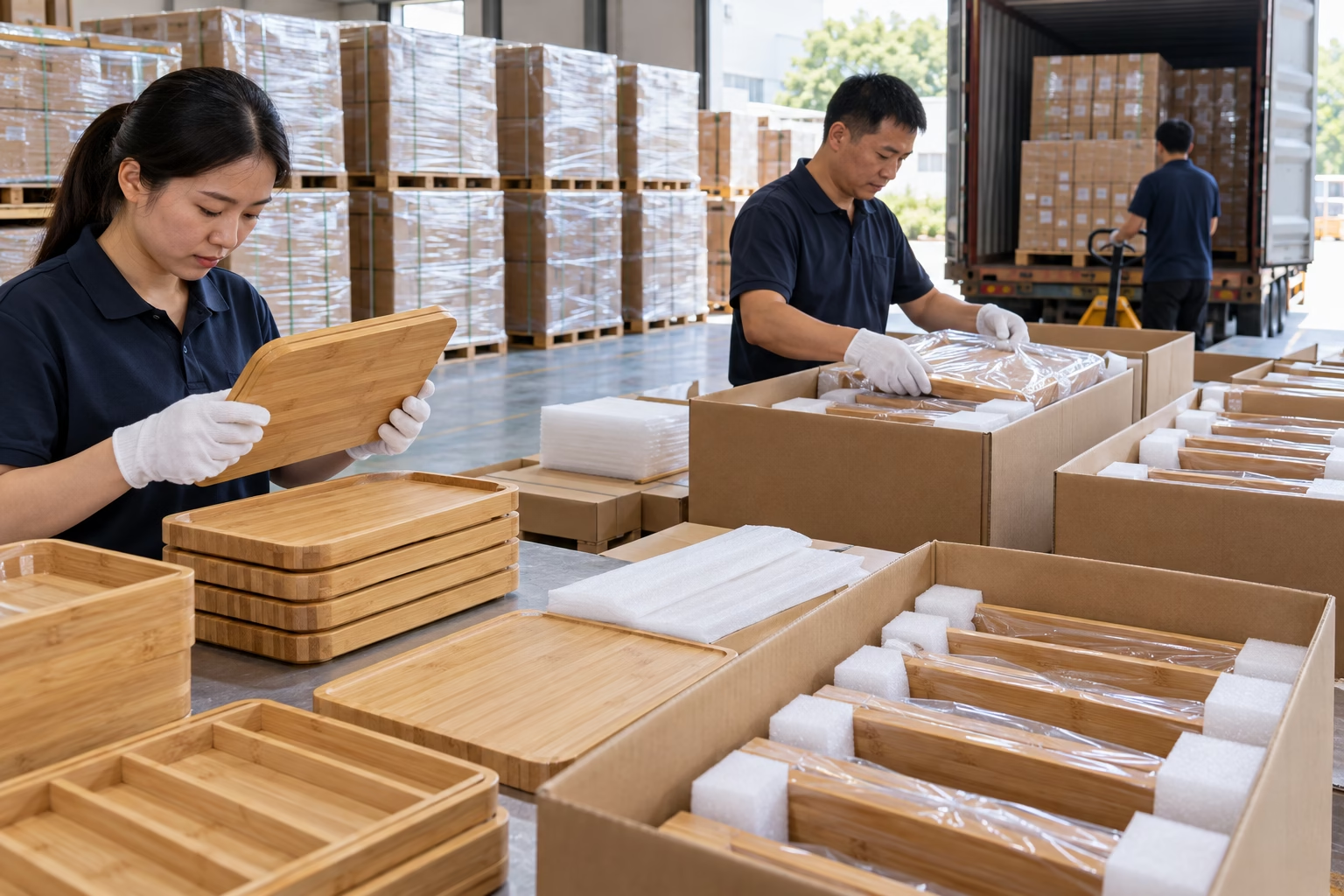
The finished product and the materials used to transport it must be reviewed separately. A wooden organizer, bamboo tray or solid-wood serving item is a finished good. A pallet, crate, dunnage or blocking used to support international cargo is transport packaging. Paperboard retail cartons and export cartons should also be described separately from any solid-wood packaging material.
Before booking, identify every pack level: sales unit, retail presentation, inner pack, export carton, pallet or crate. Record carton dimensions, orientation, quantity, labels, barcodes, inserts and pack fit against the approved configuration. SHENGLIAN’s packaging planning can control these project inputs, but there is no universal carton count, protective method or acceptance threshold for every order.
Where pallets, crates or dunnage may be made from solid wood, ask the broker or forwarder to confirm the applicable treatment, marking and entry conditions for the shipment route. Consult current USDA APHIS guidance on wood packaging material rather than assuming that requirements for transport packaging are the same as those for the finished bamboo or wood product.
Packaging Hierarchy Checklist
- Sales unit: Confirm the product, protective materials and presentation requirements.
- Retail or inner pack: Check artwork, labels, barcodes, inserts, orientation and quantity.
- Export carton: Confirm measured dimensions, contents, carton markings and pack fit.
- Transport packaging: Identify pallets, crates, dunnage or blocking and their material status.
- Evidence: Retain final pack-out photographs, inspection records and buyer-approved artwork.
- Responsibility: Assign packaging review to the buyer, supplier, forwarder or broker as appropriate.
Do not infer package or gross weight from the outside carton envelope. Use measured final packing data, and keep net product mass separate from packaging mass. Any treatment or marking decision for wood packaging should be recorded as confirmed, pending broker review or requiring supplier or forwarder evidence.
Use Sample Approval and Staged QC as the Final Release Gate
Import preparation should end with a release decision tied to the actual goods, not only to an early quotation or digital drawing. Approve the product dimensions, construction, appearance, function, branding and packaging against the controlling specification and physical sample. A sample approval confirms the agreed reference; it does not replace inspection of production output.
SHENGLIAN uses five quality-control stages: incoming material, first article, in-process, finished product and pre-shipment inspection. The applicable characteristics, methods, sample basis and acceptance criteria remain project-specific. Depending on the product, checks may address usable dimensions, fit, surface condition, moisture-related movement, decoration, missing components, pack fit or packaging damage.
Pre-Shipment Release Checklist
| Release area | Required record | Owner | Decision |
|---|---|---|---|
| Product | Approved sample and controlling specification | Buyer and supplier | Release / action open |
| Materials and claims | Declaration, finish details and intended-use review | Buyer and supplier | Confirmed / specialist review |
| Documents | Aligned descriptions, quantities, values, origin and weights | Buyer and broker | Accepted / correction needed |
| Packaging | Final pack-out, labels, carton data and wood-packaging status | Supplier and forwarder | Ready / evidence required |
| Inspection | Results, deviations, disposition and supporting evidence | Supplier and buyer | Pass / hold / corrective action |
Keep each drawing, specification, artwork file, packaging brief and physical sample identifiable by its own revision and approval date. A single release log should cross-reference the exact versions reviewed and approved together. Shipment should remain on hold when an unresolved product, document, packaging or broker-review item has no named owner or disposition.
For a project-specific handoff, send SHENGLIAN the intended use, material breakdown, controlled drawings, approved sample observations, destination, packaging hierarchy and evidence needs through How to Prepare a Custom Product RFQ. This gives the factory a structured basis for confirming product details, packaging inputs and export coordination before booking is finalized.
For the related sample and development process, see Prototype and Sample Development.
Frequently Asked Questions
Who is responsible for US import compliance: the buyer, broker or manufacturer?
The importer of record holds the import responsibility. The customs broker supports entry preparation, while the manufacturer supplies accurate product, material and shipment information. Responsibilities should be agreed before production and booking.
Does importing bamboo products into the US require the same review as importing solid wood products?
No. Review depends on construction, intended use, origin, classification, packaging and current agency requirements. Bamboo, solid wood, composite products and transport packaging should be described separately.
What product information should a customs broker receive before production?
Provide the product name, intended use, dimensions, construction, material breakdown, finish, components, origin, photographs, packaging hierarchy and proposed commercial-document description.
What documents commonly support a bamboo or wood product shipment?
Common documents may include a commercial invoice, packing list, bill of lading or air waybill, purchase-order reference and requested product or material declarations. The broker should confirm the final document set.
How should wood pallets, crates or dunnage be reviewed before export?
Identify whether solid wood transport packaging is used and ask the broker or forwarder to confirm applicable treatment, marking and entry conditions using current USDA APHIS guidance.
Does a material declaration replace food-contact testing or other product compliance evidence?
No. A declaration records composition. Testing, food-contact review and other compliance evidence address separate questions and must be evaluated for the specific product, finish and intended use.