
To store bamboo products before export, hold finished goods in a clean, dry, weather-protected area where water exposure, dirt, pests, handling impacts and unsuitable compression are controlled. Keep finished goods separated from work in progress and rejected stock, then connect every order to its SKU, variant, packaging version and release status. This storage-stage control should be agreed alongside Packaging, Warehousing and Export Preparation.
Finished-goods storage is different from raw-material conditioning, retail packaging design and ocean-transit protection. Bamboo or wood construction, finish, packaging and destination environment determine the relevant moisture and stability checks. Storage controls reduce risk, but they do not prove that a shipment meets destination-country import, plant-health or biosecurity requirements.
Store Finished Bamboo Products Clean, Dry, Protected and Traceable
The practical rule is to control four outcomes: clean, dry, protected and traceable. A clean area limits dust, loose debris and contamination around kitchenware, tableware, home organization products and branded gifts. A dry, weather-protected area reduces avoidable exposure from roof leaks, wet floors, open loading areas and wet cartons. Where practical, cartons or pallets should be positioned to reduce contact with dirty or potentially damp surfaces while preserving inspection access.
Protection also includes stable handling and suitable compression. Repeated movement, unstable stacking or pressure from an unsuitable load can damage corners, assembled parts, retail presentation or export cartons even when the product itself was manufactured correctly. Finished goods should be clearly separated from work in progress, packing materials, rework, rejected goods and stock awaiting approval.
Traceability means that physical labels and records keep the buyer’s order, SKU, product variant, branding version, packaging version and destination connected. This is especially important when similar serving boards, trays or organizers share a warehouse. SHENGLIAN reports approximately 12,000 square metres of production and warehousing facilities, but that company-level figure is not evidence of the storage condition for a particular order. Current project controls still require confirmation.
Buyer Questions Before Dispatch
- Where will completed goods be held, and how are leaks, standing water and open-weather exposure controlled?
- How are finished goods separated from work in progress, hold stock, rework and rejected goods?
- How are dirt, pests, compression and handling incidents recorded?
- What dated photographs, identification records or release checks can be provided before loading?
Identify the Storage Risks That Can Damage or Confuse an Export Order
Moisture-related damage in bamboo products is not defined by one universal warehouse number. Bamboo and wood-based parts exchange moisture with surrounding air, and movement depends on construction, finish, condition and destination use. Exposure may show as dimensional change, joint movement, swelling, coating or surface change, unusual odor, or damage to the packaging. A manufacturing defect and transit damage can produce similar symptoms, so the storage history and inspection record matter.
Contamination risks are easier to investigate visually. Dust, loose debris, pest evidence, dirty surfaces or compromised cartons can indicate that housekeeping and inspection controls need attention. Pest-management records may support a warehouse review, but they do not by themselves establish compliance with an importing country’s biosecurity rules.
| Storage risk | What the buyer may observe | Control to ask about | Evidence to request |
|---|---|---|---|
| Water or condensation exposure | Wet cartons, odor, swelling or surface change | Weather-protected storage and incident escalation | Dated area and carton photographs; inspection record |
| Dirt or pest contamination | Dust, debris, evidence of pests or soiling | Housekeeping and inspection routines | Unaltered storage photographs and applicable records |
| Compression or handling impact | Crushed corners, unstable stacks or damaged components | Stable placement, movement controls and carton checks | Carton-condition review before loading |
| Mixed lots or variants | Similar goods with different labels or presentations together | Physical segregation and readable identifiers | Inventory or release status linked to each variant |
When a carton is wet, crushed, dirty or associated with an unexplained lot mix-up, separate it from release stock, record the condition, identify the affected order or variant and request a technical or quality decision. Do not treat an undamaged outer carton as proof that the product and retail pack were unaffected.
Write a Finished-Goods Warehouse Requirement the Supplier Can Verify
A useful warehouse requirement describes an observable control, assigns responsibility and states what evidence supports release. Avoid vague wording such as “store carefully.” Specify protection from roof leaks, standing water, direct weather, excessive dust and uncontrolled access. State how goods will be separated from floors or walls where appropriate, while allowing safe movement and inspection.
| Control | Why it matters | Owner | Acceptable evidence |
|---|---|---|---|
| Weather-protected finished-goods area | Reduces avoidable water and dirt exposure | Warehouse or operations lead | Dated photographs and incident record |
| Segregation by order and status | Prevents release of hold, rework or rejected goods | Warehouse and quality teams | Location labels and inspection-status record |
| Variant and packaging identification | Prevents mixed-lot loading | Warehouse and export teams | Redacted inventory or release record |
| Pre-loading carton inspection | Finds wet, dirty or crushed packaging before dispatch | Quality or appointed inspector | Completed checklist and photographs |
For moisture checks, the requirement should name the material and construction, measurement instrument or method, sampling basis, reference condition, destination assumptions and acceptance owner. An 8-12% range can be used only as a conditional indoor planning reference when applicable; it is not a universal SHENGLIAN acceptance limit or a guarantee against movement.
Example: Applied Pre-Dispatch Storage Review
A US buyer has an approved bamboo homeware product and packaging sample, but the shipment contains multiple variants and no current storage or pre-loading evidence has been supplied. The buyer should not treat production completion as dispatch readiness. The next action is to request dated storage photographs, variant identification records, carton-condition checks and release status for each variant before booking.
SHENGLIAN can translate a buyer’s storage brief into a project-controlled workflow after internal confirmation. The buyer and manufacturer should agree who may move goods, how incidents are recorded, who can authorize release and whether the decision is to accept, hold for evidence or investigate.
Protect the Product, Retail Pack and Export Carton as Separate Layers
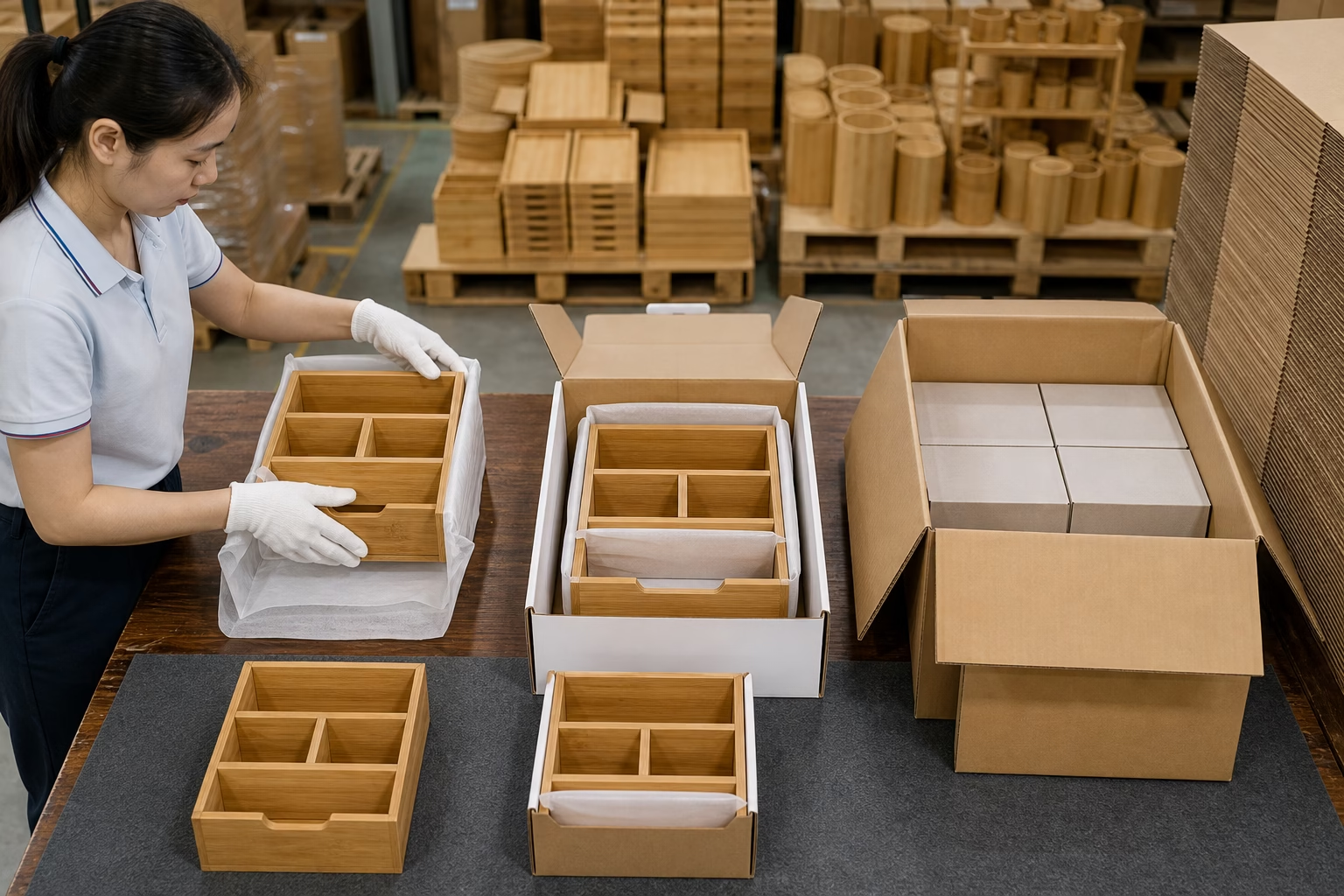
Finished-goods storage should be checked at three levels: the bamboo or wood product, the unit or retail pack, and the export carton or palletized load. A dry outer carton does not prove that the product avoided movement or surface damage, while a sound product can still arrive with crushed, dirty or poorly presented retail packaging.
For custom kitchenware, home organization products, bathroom accessories or branded gifts, compare each layer with the approved sample and current packaging specification. Check the product’s surface, edges, assembly and usable fit; then check pack orientation, sales unit, quantity, labels, artwork, barcodes and inserts. Keep outside carton dimensions separate from usable internal dimensions when evaluating fit.
Can moisture damage bamboo or wooden products while they wait for shipment?
Yes. Moisture exchange may affect dimensions, joints, surfaces, coatings, odor or packaging, depending on construction, finish and destination conditions.
What warehouse evidence should a buyer request before loading?
Request dated storage photographs, identification records, carton-condition checks, inspection status and a release decision for each relevant variant.
How can buyers prevent mixed SKUs or incorrect branded packaging?
Connect the purchase order, SKU, variant, packaging version and destination to physical carton markings, then reconcile those records before loading.
Should finished products be stored separately from raw materials and work in progress?
Yes. Clear segregation reduces mix-ups and makes inspection, hold status, rework control and shipment release easier to verify.
For the related sample and development process, see Prototype and Sample Development.
Frequently Asked Questions
Do clean warehouse conditions guarantee protection during ocean transport?
No. Storage controls reduce pre-dispatch risk but do not guarantee transit performance or prove destination-country import compliance.
What should be done if cartons are wet, crushed or dirty?
Record the condition, isolate the affected goods where appropriate, and hold release until the buyer and manufacturer agree on inspection, correction or replacement action.