For custom logo wooden bowls, choose a branding method by matching the artwork and desired retail effect to the bowl’s material, construction, finish, shape and intended use. SHENGLIAN verifies laser engraving and screen printing, but suitability and appearance depend on the actual bowl, logo and proposed position. Compare methods using the bowl drawing or reference sample, then approve the result on a physical branded sample. Start with the selected Custom Bamboo and Wooden Bowls form, not the logo file alone.
Laser engraving makes a mark on the surface and may suit a tonal, engraved look when the artwork and surface support it. Screen printing applies a graphic to the surface and may suit a colour-led design when compatibility is confirmed. If the main branding goal is shelf communication, packaging can carry the identity without a visible product mark. The right choice is conditional: bowl curvature, laminated transitions, foot rings and finish can change how consistently a mark appears.
Choose the Branding Method From the Bowl and the Buying Moment
Begin with the buying moment: will customers notice the bowl in a retail display, handle it during use, receive it as a gift, or see it mainly in product photography? Then match that role to the logo’s detail, size, colour intent and location. A simple tonal mark may make engraving worth evaluating; a graphic that depends on colour may point toward screen printing. Packaging-led branding is another option when product decoration is not essential to the presentation.
For a useful recommendation, send the manufacturer a current drawing or reference bowl, material and construction details, finish direction, artwork, proposed logo size and position, intended use and retail context. Identify which details are fixed, preferred or still open. SHENGLIAN verifies engraving and screen printing as methods; the actual bowl and artwork must still be reviewed before feasibility or appearance can be confirmed.
Method-Selection Matrix
| Decision factor | What to compare | Buyer’s next step |
|---|---|---|
| Artwork | Fine lines, small text, solid areas and colour requirements | Send the artwork and state which details must remain legible |
| Bowl form | Curved wall, flat base, foot ring, joints or laminated transitions | Mark the proposed area on a drawing or bowl photograph |
| Use and handling | Serving, display, gifting, stacking and expected handling | Describe use and whether the mark may be in a contact area |
| Retail effect | Visible product logo, colour graphic or branded packaging | Specify what shoppers should see in display and packed presentation |
Hypothetical Buyer Scenario
A US private-label buyer has a laminated bamboo serving-bowl concept and vector artwork but has not set the logo size, position or colour requirements. Because there is no physical branded sample to show contrast, curvature or interaction with the finish, the artwork file alone cannot settle engraving versus printing. The practical next step is to submit the bowl drawing or reference sample, proposed placement, colour intent, use case and packaging brief, then request method recommendations against that bowl or a sample trial.
Compare Laser Engraving, Screen Printing and Packaging Branding
Compare the options by visual character and retail role, not by assuming a universal line limit, colour match or durability outcome. Artwork detail and surface contrast may affect which method is worth sampling. Personalised names or other variable artwork also need separate workflow confirmation because each unit may require different content.
| Option | Appearance and artwork fit | Placement and retail role | Approval evidence |
|---|---|---|---|
| Laser engraving | Surface mark; evaluate tonal contrast and whether fine details remain clear | Product mark where the selected surface and form allow review | Artwork review and physical branded bowl sample |
| Screen printing | Applied graphic; evaluate colour intent, solid areas and detail on the actual finish | Product graphic in a confirmed usable area | Artwork proof and physical sample showing the intended colour and position |
| Packaging-led branding | Printed or otherwise branded retail presentation, with no required product mark | Retail pack, inner packing or export carton, specified separately | Packaging artwork and pack sample or other agreed review record |
For either product method, ask what the sample will be judged against: approved artwork, logo position and orientation, visible appearance, bowl function and the intended inspection view. For packaging, specify the sales unit, pack orientation, dimensions, quantities, artwork, labels, barcodes and inserts where applicable. Product presentation, retail packaging, inner packing and export cartons are separate controls; approval of one does not automatically approve the others.
Select a Branding Zone That Remains Visible and Usable
A branding zone is the usable surface selected for the mark. Common choices include the exterior sidewall, base, rim or interior; packaging-only branding avoids marking the bowl itself. Choose according to when the logo should be seen. A base mark may be visible in photography or when the bowl is lifted, while a sidewall mark may show during display. A logo on the interior could interact with the intended use, so state whether the bowl is for serving, display or decoration and identify any relevant contact area.
Describe placement against the specific bowl, not a generic diagram. Outside dimensions describe the bowl’s overall size; usable dimensions describe the available area for the logo and may be constrained by the wall’s curve, foot ring, recess, joint or rim. Request front, top and base views with logo orientation, position, maximum area and clearance from edges or features. Include the views used for photography, retail display, stacking and packed presentation if those affect approval.
Reusable Branding-Zone Brief
- Bowl reference: Drawing or sample, material, construction and finish.
- Location and orientation: Exterior sidewall, base, rim, interior or packaging; indicate logo direction relative to the bowl.
- Size and clearance: Proposed logo dimensions, usable area and distance from rims, feet, recesses or joints.
- Visibility and use: Intended use, handling exposure, stacking and retail or photography views.
- Review basis: Front, top and base views, plus the physical branded sample used for approval.
SHENGLIAN evaluates placement against usable dimensions, surface and function on the selected bowl form. A location that appears clear in a flat artwork proof may look different on a curved wall or across natural grain; the physical sample is the reference for deciding whether the position and appearance meet the brief.
Align Artwork With Construction, Grain, Moisture and Finish
A logo should be judged on the finished bowl surface, not only on a clean digital proof. Before approving engraved wooden bowls or printed graphics, identify whether the bowl is solid, laminated, panel-based or multi-component. Construction can affect grain direction, visible joints, lamination lines and machining transitions in the proposed branding zone.
Natural variation is part of the appearance review. Record the expected visible faces, grain direction, edge feel, colour or gloss direction, contact areas and finish system in the specification. A mark that appears clear across one surface may present differently over changing grain or a transition between components. Moisture or another reference condition should also be stated for sample comparison, without treating a general planning reference as a universal factory requirement.
Branding Surface Specification Brief
- Construction: State solid, laminated, panel or multi-component construction and identify visible joints or transitions.
- Surface: Describe the visible faces, sanding or preparation expectation, edge feel, natural variation and approved finish.
- Appearance: Record colour or gloss direction, grain orientation and the approved sample used for comparison.
- Branding zone: State the location, usable area, logo orientation and any contact or handling exposure.
- Reference condition: Identify the condition and measurement basis used to compare the sample with production.
- Open questions: List any unresolved issues about contrast, finish interaction, food-contact exposure or destination evidence.
SHENGLIAN evaluates branding feasibility against the actual material, construction, surface and finish. Appearance approval is separate from claims about adhesion, food-contact suitability or long-term durability. Those claims require a defined use, method and supporting evidence.
Control Dimensions, Machining and Logo Acceptance Through Sampling
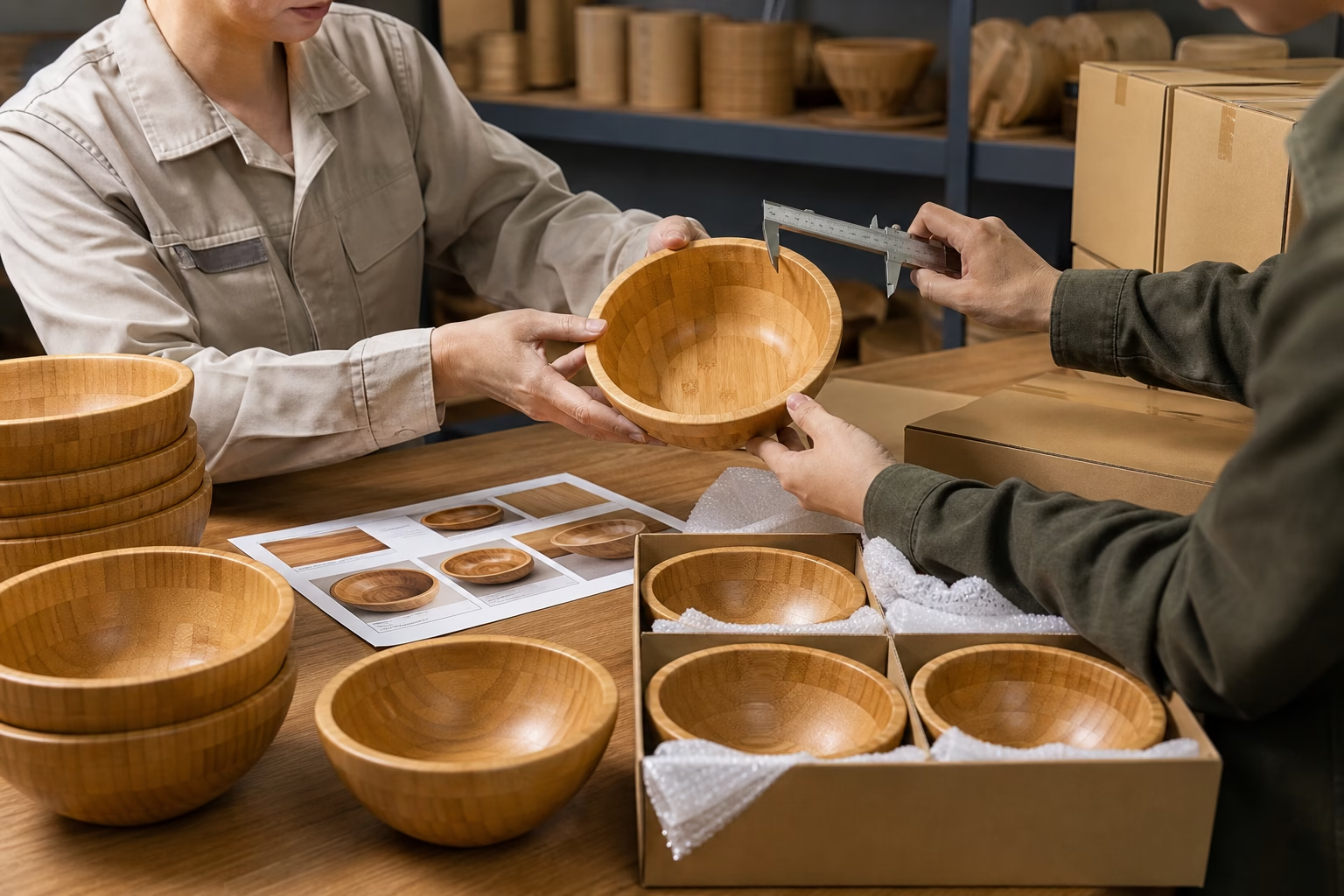
Sampling turns a branding idea into something the buyer can inspect. The product brief should identify critical bowl dimensions, usable branding dimensions, logo position and any buyer-agreed tolerances. Outside dimensions describe the overall bowl; usable dimensions describe the area available for the mark after curvature, feet, recesses, rims or joints are considered.
Review the complete sequence that can affect the result: forming or cutting, machining, sanding, finishing, branding and assembly. The logo should be judged after the relevant surface and finish work, because a digital artwork proof cannot show the interaction between the mark, grain, curvature and final appearance.
Logo Approval Checklist
- Artwork proof: confirm the controlling artwork, logo proportions, colour intent, variable elements and orientation.
- Placement: confirm the usable area, position, clearance and inspection views on the selected bowl.
- Surface: compare grain, joints, finish, edge feel and visible variation with the approved appearance reference.
- Dimensions: measure the defined critical and usable dimensions using the named unit and method.
- Function: inspect the bowl for the intended use and any relevant contact or handling exposure.
- Packaging: check product presentation, retail pack, inner packing and export carton requirements separately.
- Deviations: record the issue, decision, responsible party and disposition rather than silently changing the brief.
SHENGLIAN’s sample workflow can cover dimensions, construction, appearance, function, branding and packaging. A practical staged process is artwork proof, physical branded sample, pre-production review and production inspection. Sample approval does not replace production inspection, and it should not be used to imply a default tolerance, AQL, engraving limit or zero-defect promise.
For controlled development, use Prototype and Sample Development to connect the physical sample with the agreed product and branding inputs. Each specification, drawing, artwork file, packaging brief and sample may have its own identifier, revision and approval date. A single release log should cross-reference the exact versions reviewed and approved together.
Connect Private-Label Bowl Branding to Packaging and Buyer Inputs
Private-label bowl branding is complete only when the product mark and retail presentation are specified together. Separate the bowl itself from the retail pack, inner packing and export carton. For each level, define the sales unit, orientation, dimensions, quantities, artwork, labels, barcodes and inserts that apply.
| Control area | Buyer input | Confirmation needed |
|---|---|---|
| Product | Use, material, construction, dimensions, finish and logo location | Approved bowl drawing or sample |
| Branding | Artwork, size, orientation, colour intent and inspection views | Artwork proof and physical branded sample |
| Retail pack | Sales unit, pack orientation, labels, barcodes and inserts | Controlled packaging artwork and pack-out review |
| Inner and export packing | Quantities, dimensions, protection and destination information | Project-specific packaging and logistics confirmation |
| Evidence | Food-contact, care, labelling or destination requirements | Buyer or regulator requirements and supporting records |
Clarify whether the logo belongs on the bowl, the packaging or both. Product presentation may require a visible mark, while packaging may carry retail information that cannot fit on the bowl. Net product dimensions and weight should also remain separate from packed or gross information when logistics data is needed. Do not assume carton counts, protective methods, transport tests or regulatory acceptance.
Use SHENGLIAN’s custom packaging brief guidance to assemble the pack levels and artwork inputs. For food-use products, separate branding appearance approval from food-contact evidence and destination-market requirements; the Food-Contact Testing Requirements Guide can help identify the information that needs technical confirmation.
For the next RFQ step, send the bowl drawing or reference sample, material and finish details, artwork, proposed branding zone, intended use, quantity, destination and packaging brief. Ask SHENGLIAN to confirm the feasible method, sample basis, inspection views and unresolved evidence needs against the selected bowl.
For relevant company and manufacturing context, see Products for E-commerce and Marketplace Sellers.
Frequently Asked Questions
Which branding method is best for custom logo wooden bowls?
The suitable method depends on the bowl surface, construction, artwork detail, colour intent, placement and retail purpose. SHENGLIAN verifies laser engraving and screen printing, but the final choice requires review against the actual bowl and an approved physical sample.
Can bamboo bowls use both laser engraving and screen printing?
Both methods may be considered for bamboo bowls when the material, finish, shape and artwork support them. Their visual result and project suitability are conditional, so request method recommendations against the selected bowl rather than choosing from a logo file alone.
Where should a logo be placed on a wooden or bamboo bowl?
Possible zones include the exterior sidewall, base, rim, interior or packaging. Choose the location according to visibility during display, stacking, use, photography and gifting, then confirm it with front, top and base views plus a physical sample.
What artwork information should buyers provide before sampling?
Provide the controlling artwork, proposed logo size, orientation, colour intent, variable elements, location and intended use. Also state which details must remain legible and whether the mark is fixed private-label artwork or variable personalization.
How does bowl shape or curvature affect logo consistency?
Curvature can change the apparent alignment and usable area of a logo. Foot rings, recesses, rims, joints, grain direction and natural variation can also affect the result, which is why the selected bowl form should be reviewed before approval.
Should the logo be approved on a finished physical bowl sample?
Yes. A physical branded sample allows the buyer to assess dimensions, placement, surface interaction, contrast, finish and packaging presentation. It provides an approval reference, but production inspection remains a separate quality-control stage.