
A complete product specification sheet records the decisions a manufacturer needs to review a custom bamboo or wood product: intended use, dimensions, material, construction, appearance, branding, packaging and approval status. It converts a concept into a controlled reference for drawings, sampling, manufacturing review and inspection. SHENGLIAN Bamboo Wood Factory treats this specification-led brief as a planning aid; actual feasibility remains subject to the submitted files, product requirements and sample evaluation. For development support, see Prototype and Sample Development.
The sheet is different from an inspiration board, catalogue, packaging brief or quotation request. Those documents may communicate direction, but they do not necessarily define what must be measured or accepted. Mark each requirement as fixed, preferred or open. A missing unit, reference condition, measurement method or acceptance criterion should remain an open decision rather than being guessed.
What to Include in a Product Specification Sheet for Custom Bamboo and Wood Products
Use the document as the shared reference between the buyer, drawing or artwork file, approved sample and manufacturer review. A target value describes the intended result; an acceptance criterion explains how that result will be judged. The controlling file is the drawing, specification or artwork version currently approved for review. The approved sample is the physical reference that confirms how written requirements have been interpreted.
| Specification field | Decision it supports | Useful evidence |
|---|---|---|
| Purpose and user | Use conditions, functions and risk areas | Intended-use statement and destination |
| Material and construction | Material route, component design and joining review | Material references, sections and component breakdown |
| Dimensions and tolerances | Geometry, fit and measurement method | Dimensioned drawing with units and datums |
| Appearance and finish | Visible-face, surface and natural-variation approval | Colour reference, finish reference and sample |
| Branding and packaging | Decoration, presentation, pack fit and labelling | Artwork, packaging layout and pack-out reference |
Technical specifications should define measurable product requirements and may also cover dimensions, production details, packaging and labelling, as explained in the technical specifications guidance from the UK Government Procurement Pathway. For a custom product, the buyer should also identify the evidence needed for review, such as supplier data, inspection records, test documentation or a physical sample.
Define Product Use, Construction and Material Before Choosing Specifications
Begin with the product’s purpose, user, sales channel and destination. A desk organizer, serving board, bathroom tray and hospitality accessory may all use bamboo or wood, but their handling, cleaning, presentation and evidence needs can differ. State whether the item is for indoor retail use, kitchen or serving use, moisture exposure, frequent handling, child use or another defined application. Food-contact, moisture-sensitive and destination-specific requirements need separate project review; SHENGLIAN’s Food-Contact Testing Requirements Guide can help frame the evidence request where relevant.
Describe the intended construction instead of leaving the structure entirely to interpretation. Identify whether the product is solid, laminated, made from joined panels or assembled from multiple components. Note compartments, removable parts, routed features, slots, handles, feet, lids or hinges where they affect function. SHENGLIAN may review preparation, cutting or forming, panel joining or pressing and assembly as applicable to the design, but the manufacturing route must be confirmed against the actual product.
Keep material preference separate from finish preference. Record the preferred bamboo or wood category, which components must use it, the expected grain direction and the acceptable range of natural colour or surface variation. Grain direction is both an appearance and construction variable, not a universal performance guarantee. When dimensional stability matters, state the reference moisture condition and measurement method. Do not treat a planning reference as an accepted production threshold without project confirmation.
Material-and-Construction Decision Matrix
| Requirement | Reason | Evidence or reference | Open question and owner |
|---|---|---|---|
| Preferred material | Controls appearance and construction review | Material sample or approved image | Is the choice fixed or preferred? Buyer |
| Grain direction | Controls visible orientation and design intent | Annotated drawing or sample | Which faces are critical? Buyer and manufacturer |
| Natural variation | Separates acceptable character from defects | Reference images or physical sample | What requires rejection or review? Buyer |
| Construction route | Clarifies joints, panels and interfaces | Section view and component breakdown | Can the proposed route meet the function? Manufacturer |
Hypothetical specification review: branded bamboo desk organizer
Example: A buyer has a concept image, a retail use case, compartments and a branded visible face. Bamboo appearance is preferred, but natural variation, overall and usable dimensions, construction route, artwork placement, finish reference, tolerance method and pack-out requirements are undefined. The material and branding should therefore be marked preferred, while production approval remains pending. The next action is to issue annotated views, branding files, measurement conditions, packaging levels and an approval checklist for technical review.
Set Dimensions, Usable Measurements and Tolerances That Can Be Verified
List the measurements that affect appearance, fit and function: overall length, width and height; component size; thickness; internal or usable dimensions; diameter; openings; interfaces and, where relevant, target weight. Use a dimensioned drawing with units, orthographic views, section views, annotated photographs or a 3D file to show shape and relationships. A photograph alone may communicate appearance while leaving geometry unresolved.
Distinguish a nominal dimension from a usable dimension. The nominal value describes the intended geometry; the usable value describes the space available for storage, insertion or handling. A tolerance defines the permitted variation, but it is meaningful only when connected to a datum, location, product condition, measurement method and functional consequence. State whether dimensions apply before or after finishing, and identify critical-to-function features separately from appearance preferences.
| Feature | Nominal value | Tolerance basis | Condition and method | Functional risk |
|---|---|---|---|---|
| Overall length | Buyer-defined | Fit or presentation need | Finished product; stated tool | Pack fit or retail display |
| Internal compartment | Buyer-defined | Required usable space | Assembled product; stated method | Item may not fit |
| Panel thickness | Buyer or manufacturer proposal | Structure and appearance | Defined moisture and finish condition | Joint or interface mismatch |
Natural-material assemblies can be affected by grain, moisture condition, finishing and assembly. A machining tolerance should not automatically be transferred to a finished bamboo or wood assembly. SHENGLIAN can review the proposed measurement basis against the controlling drawing, product condition and approved sample, but any project-specific threshold must be confirmed before it becomes an acceptance criterion.
Specify Machining, Joinery, Sanding, Finish and Branding as Reviewable Features
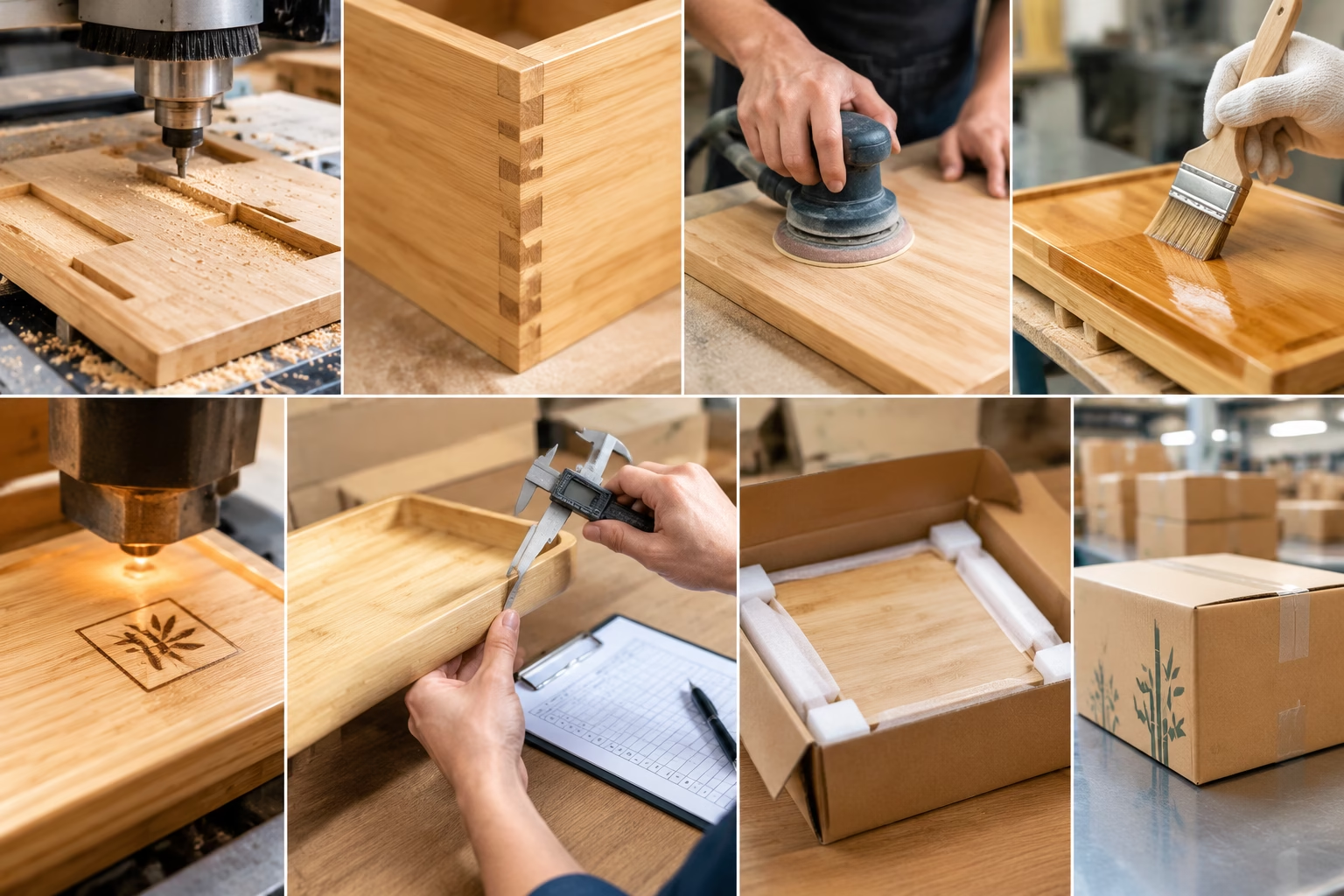
A useful product specification sheet translates appearance and construction ideas into features that can be reviewed against a drawing, reference image or approved sample. Identify cutting, forming, routed details, holes, slots, handles, feet, lids, hinges and removable parts. For joined or pressed panels, show interfaces and functional checks instead of assuming that an unnamed construction method will produce the intended result.
Separate design intent from the manufacturing route. Depending on the product, SHENGLIAN may review cutting or forming, panel joining or pressing, CNC work, sanding, finishing and assembly. The applicable route depends on the actual design and evidence supplied. A specification should therefore describe the required result first, while leaving the feasible process open for technical review.
For visible surfaces, define the face, edge feel, surface texture, colour direction, sheen, natural variation and areas that will be touched or cleaned. A sanding sequence or coating count alone does not establish durability, adhesion or food-contact status. Where those claims matter, request project-specific documentation and agree the inspection or test basis before treating the requirement as accepted.
Finish and Branding Review Checklist
- Visible surfaces: Identify the faces, edges and contact areas that receive particular attention.
- Appearance: Provide a colour, gloss, texture or physical reference, and state which natural variation is acceptable.
- Construction: Show joinery, interfaces, removable parts and functional checks in drawings or annotated views.
- Finish: Record the intended finish system, cure or readiness condition and inspection method when known.
- Artwork: State branding position, scale, orientation, legibility, colour and the approved artwork reference.
- Evidence: List requested adhesion, food-contact or other performance documentation without assuming it is automatically available.
Hypothetical Specification Review: Branded Bamboo Desk Organizer
A buyer has a concept image, a high-level retail plan and a preferred bamboo appearance for a desk organizer with compartments and one branded visible face. The evidence gap is significant: overall and usable dimensions, construction route, artwork placement, finish reference, measurement method and pack-out details are not yet controlled.
The practical decision is to classify the bamboo appearance and branding as preferred requirements, while holding production approval until annotated views, artwork and a physical sample are reviewed. The next action is to issue a specification brief covering measurement conditions, branding files, packaging levels and sample-approval checks. This turns incomplete intent into reviewable decisions without presenting invented values as factory standards.
Use Sample Approval and Staged Quality Control to Release the Specification
A sample is a validation reference, not an automatic production acceptance. Compare it with the controlling drawing, specification, artwork and packaging information. Check dimensions, construction, appearance, function, branding and pack fit as relevant to the product. SHENGLIAN describes prototype development as a validation stage before bulk production, but the buyer still needs to record what was accepted and what remains open.
Keep a plain-language release record for the specification, drawings, artwork, packaging brief and physical sample. Each item may have its own identifier, revision and approval date. The release record should cross-reference the exact versions reviewed and approved together. This prevents a later artwork change or revised drawing from being treated as part of an earlier approval by assumption.
Sample Evaluation and Release Checklist
| Review area | Evidence to record | Decision |
|---|---|---|
| Material and construction | Material reference, component breakdown, joints and assembly observations | Accepted, deviation noted or manufacturer review pending |
| Dimensions and function | Measured features, usable space, fit checks and stated method | Meets the agreed criterion, requires correction or remains open |
| Surface and branding | Visible-face observations, colour or gloss reference, artwork position and legibility | Approved against reference or returned with a specific change |
| Packaging | Pack level, orientation, product fit, labels and visible damage | Approved for the intended stage or revised for another sample |
| Release control | Deviation, owner, next action, file versions and approval date | Released, conditionally released or not released |
Distinguish visual, dimensional, functional and documentary observations. A colour mismatch is not recorded in the same way as an unusable compartment or missing test record. Production inspection should remain separate from sample approval, with project-specific acceptance criteria and evidence defined before bulk release.
Complete Packaging, Artwork and Buyer Inputs Before Production Release
Packaging should be coordinated with the approved product rather than added as a late purchasing detail. Separate product presentation, retail packaging, inner packing and export carton requirements. Record the sales unit, orientation, pack level, dimensions, quantity, labels, barcodes, inserts and artwork where applicable. Distinguish product dimensions from usable pack dimensions and from shipping-pack dimensions.
State the destination, handling assumptions and requested packaging evidence. Do not assume a universal carton count, protective method or transport test. Retailer instructions, destination rules and logistics conditions may change the required documentation. Include packaging in final sample approval so pack fit, artwork, labelling and visible damage are checked with the product.
Reusable Specification Brief
- Product and use: Product name, purpose, user, sales channel, destination and handling conditions.
- Construction: Solid, laminated, panel or multi-component structure, with interfaces and removable parts shown.
- Dimensions: Overall and usable measurements, units, critical features, tolerance basis, condition and method.
- Material and appearance: Material preference, grain direction, acceptable variation, visible faces, colour, gloss and surface feel.
- Branding: Artwork reference, position, scale, decoration method under review and legibility criteria.
- Packaging: Presentation, retail, inner and export levels, pack-out, labels, inserts, quantities and evidence requests.
- Control status: Mark each item as fixed, preferred or open, then name the owner and next decision.
Once these inputs are assembled, upload the completed product specifications with the controlling drawings, artwork, packaging information, approved references and open questions. SHENGLIAN can then assess the actual brief for project-specific technical review; unresolved values should remain open until the relevant file, sample or manufacturer confirmation closes them.
For relevant company and manufacturing context, see Products for E-commerce and Marketplace Sellers.
Frequently Asked Questions
What is a product specification sheet for a custom bamboo or wood product?
It is a structured reference for intended use, dimensions, material, construction, appearance, branding, packaging and approval status. It connects buyer requirements with drawings, samples, manufacturing review and inspection.
Which dimensions should a bamboo or wood product specification sheet include?
Include overall, component, internal, usable, thickness, diameter and weight requirements where relevant. Add units, reference views, critical features, measurement condition, method and the functional consequence of variation.
How should buyers specify natural grain and colour variation?
Describe grain direction, visible faces, colour direction and acceptable natural variation with images, colour references or an approved physical sample. Separate acceptable variation from defects requiring review.
Should a specification sheet include manufacturing tolerances?
Yes, when a feature affects fit, function or presentation, but do not copy a generic tolerance into the document. Connect each value to a nominal dimension, datum, product condition, measurement method and acceptance decision.
What should buyers check when approving a custom product sample?
Compare material, construction, dimensions, function, surface, branding and packaging against the named files and physical reference. Record deviations, owners, next actions and the exact versions approved together.
How should artwork and packaging requirements be documented?
Provide controlled artwork and define position, scale, colour, orientation and legibility. Document presentation, retail, inner and export packaging separately, including pack-out, labels, inserts, destination and requested evidence.